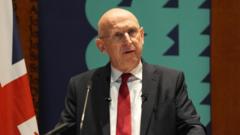
Healey wanted UK to join global defence bank, BBC told PA Media John Healey wearing a dark suit and red tie standing before a microphone Former Defence Secretary John Healey was privately pushing for the UK to join an international investment bank to raise more money for defence spending, BBC News has been told.
Allies of Healey claim the Treasury tried to shut down negotiations for the UK to join the Defence, Security and Resilience Bank (DSRB), an idea spearheaded by Canada. In his resignation letter Healey said there were "credible ways" to fund extra defence spending, including "working multi-nationally".
A government spokesperson said they were exploring setting up a "multilateral defence mechanism" with Finland, the Netherlands and others "to improve value for money" in defence procurement will allies. Treasury sources claimed Healey never submitted an official request for funding related to the UK's membership of the DSRB.
The DSRB, which aims to help member countries fund defence projects at low costs, is expected to be officially launched at a Nato summit next month. Membership of the bank for the UK and other G7 countries would come with an upfront investment cost of around £870m spread over three years.
Canadian prime minister Mark Carney, who has been pushing the idea on the global stage, is said to be keen for the UK to join the project. Ministers have been mulling it for months but the chancellor is thought to have been unwilling to pay. Healey resigned as defence secretary on Wednesday, saying the amount of money attached to the government's upcoming Defence Investment Plan fell "well short" of what was needed.
Sir Keir Starmer told the BBC on Friday he had made "hard-edged" choices on defence spending, including asking government departments to make cuts to help pay for it. The Defence Investment Plan has yet to be announced. Healey said Number 10 and the Treasury were prepared to give around £10bn in additional money in this plan, around £18bn less than what military chiefs have reportedly asked for.
It is understood Healey believed joining the DSRB could have helped bridge a funding gap as well as supporting British businesses in the defence sector. A group of defence-focused Labour MPs have been lobbying ministers to look more closely at the DSRB for months.
One advocate of the UK joining the bank said it was likely that the up-front cost would have to be paid for by borrowing. Earlier this week Chancellor Rachel Reeves indicated she was not in favour of borrowing more money to increase defence spending. But other DSRB supporters say the money should instead be viewed by ministers as an investment.
One idea being pushed by some MPs is for membership of the DSRB to be funded through the National Wealth Fund, a Treasury-owned investment vehicle. MPs on Parliament's Business and Trade Select Committee visited Canada last week to discuss the DSRB. Liam Byrne, the Labour MP who chairs the committee, has written to the prime minister asking if he will look again at the DSRB in light of Healey's resignation.
The Canadian High Commissioner to the UK told Politico Gordon Brown, who is advising the prime minister on global finance, has held direct talks with Carney about the DSRB. Supporters hope it will lead to direct low-cost lending to governments as well as credit guarantees for commercial banks that give loans to defence companies.
But some in Whitehall have raised concerns the model being offered would be more likely to benefit smaller economies with lower credit ratings. Meanwhile, Conservative leader Kemi Badenoch says she has written to Sir Keir - as well as his potential Labour leadership rivals - urging them cut welfare spending to enable more funding for defence.
She offered her party's support "in the national interest" to get legislation through parliament. In the letter sent to Sir Keir, Andy Burnham, Wes Streeting, Al Carns, Catherine West, Darren Jones and Ed Miliband, Badenoch said: "We cannot have our military inadequately funded at a time of growing threats." Are the Downing Street dominoes about to fall?
'World-leading' drone warfare facility opens 'Our great-uncle's WW1 death reunited us 100 years later' Armed forces minister Al Carns speaking during a visit to RFA Lyme Bay in Gibraltar, a bay-class landing ship dock which is being upgraded by the Royal Navy to add new cutting-edge uncrewed equipment, allowing it to be used as a 'mothership' for autonomous systems, if needed for operations in the Strait of Hormuz.
Picture date: Friday May 22, 2026 Armed forces minister quits after Healey exit as defence funding row deepens Al Carns says the military isn't "sufficiently funded", as Dan Jarvis becomes the new defence secretary. A composite of two pictures: On the left a screengrab of Healey's resignation letter.
On the right, John Healey carries a red folder Defence Secretary John Healey and Armed Forces Minister Al Carns resignation letters in full Healey and Carns spell out why they have quit government in letters to Prime Minister Sir Keir Starmer. Secretary of State for Defence John Healey arrives for a cabinet meeting wearing a dark suit and red tie Healey quits as defence secretary in row over military spending He says a defence funding plan "falls well short", as Sir Keir Starmer insists he will keep the UK safe.
John Healey standing in front of the flags of the US, UK and Australia Why defence funding deal offered to Healey wasn't enough to keep him The defence secretary was pressing the prime minister for a larger increase in defence spending than he was offered, the BBC understands.
Sir Keir Starmer and John Healey pictured together. Both men are wearing dark suits and white shirts, with Sir Keir in a blue tie and Healey in a red tie. Chris Mason: Healey's resignation is a devastating critique of Starmer's government An already politically weakened prime minister has been weakened further by the resignation of the defence secretary.
The BBC is in multiple languages Read the BBC In your own language Copyright 2026 BBC. All rights reserved. The BBC is not responsible for the content of external sites. Read about our approach to external linking.